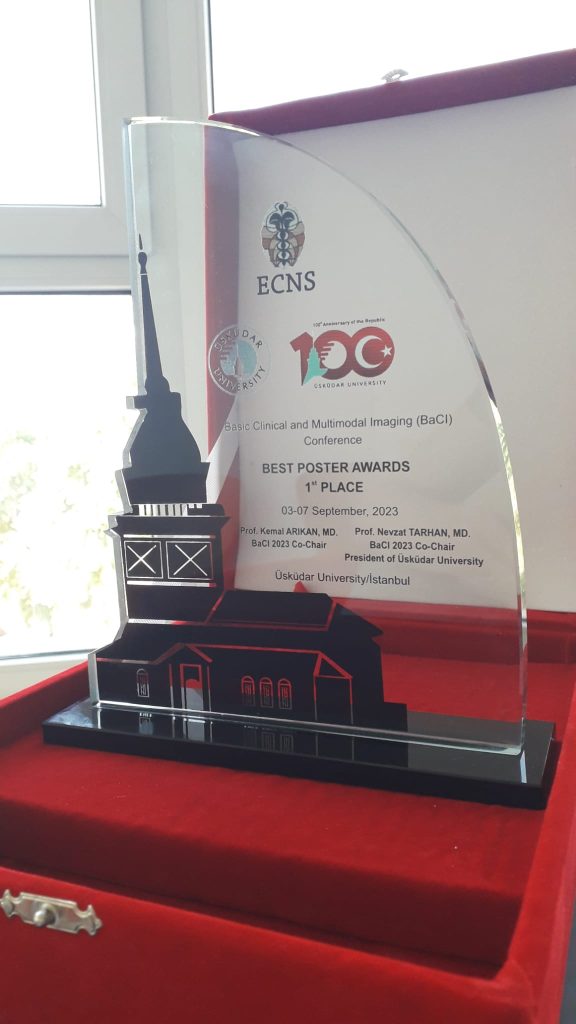
At the International Conference on Neuro-electrophysiology and Genetics, Basic and Clinical Multimodal Imaging, held this year at Uskudar University in Istanbul, the STAD project team won first prize for the best poster – ‘Personality moderates intra-individual variability in EEG microstate and spontaneous thoughts.’ presented by Alexandra Sofonea.
We have presented that the associations between EEG microstates and spontaneous cognition significantly changed from one day to another.
BACI is The Meeting Point of Neuroelectrophysiology & Genetics
September 03-07,2023
About BACI conference:
“There are several methodologies that have been used to explore the human mind; among these, neuro-electrophysiological techniques have shown great utility for clinicians as well as scientists. Among the questions being answered via those methods are therapy response prediction and diagnosis of pathologies, however there are still some shortcomings of methods like EEG/qEEG despite tremendous experience and data in hand. Multimodal approaches are in routine use in order to overcome the problems related to reproducibility, sensitivity, specificity and other statistical points. The next obvious frontier is the genetic basis of the electrophysiological markers, which will be very important to explore the state-trait dependent dichotomy. As such, we have focused this conference to shed light on the meeting point of the electrophysiology and genetics.”